






When pet owners compare cat litter products, dust is often one of the first visible differences.
Two products may both be made from wood, yet one can pour cleanly while the other creates a noticeable cloud of fine particles. The difference is not necessarily caused by the raw material alone.
Dust generation is influenced by the entire manufacturing chain.
Raw-material structure, drying conditions, forming pressure, cooling, screening, conveying, and packaging can all affect the amount of fines that appear in the final bag.
For manufacturers, reducing unnecessary dust requires a process-wide approach.
Dust Starts with the Raw Material
The first source of variation is sawdust itself.
Very fine sanding residue behaves differently from larger sawmill particles.
Long wood fibers may create different pellet structures from short, fragmented particles.
Moisture can also influence how easily particles separate during transportation.
A manufacturer receiving mixed material from several sources should therefore evaluate the raw feedstock before production.
A more consistent input makes it easier to create consistent output.
The Problem with Excessively Fine Material
It might seem logical that extremely fine wood particles would create smoother pellets.
In reality, very fine material can create additional processing challenges.
Fine dust has a high surface area and can behave differently during feeding and compression.
It can also accumulate in areas of the production system and increase dust-control requirements.
This does not mean fine sawdust is unusable.
Rather, the manufacturer should understand its characteristics and design the preparation stage accordingly.
Moisture and Dust Are Connected
Moisture influences how wood particles interact.
When material enters the system with inconsistent moisture, some particles may form more easily than others.
During drying, uneven heat transfer can create variation within the feedstock.
This variation may later appear as differences in pellet stability.
The purpose of drying should therefore be uniform conditioning rather than simply aggressive moisture removal.
A stable moisture range gives the forming stage a more predictable feed.
Pellet Density Is Another Variable
Density affects how a pellet behaves during handling.
A very soft pellet may break apart more easily when transported.
A very dense pellet may remain stable but behave differently when exposed to liquid.
Manufacturers must therefore identify the balance appropriate for the product.
For low-dust litter, resistance to abrasion is particularly important.
The product needs enough mechanical stability to survive movement through conveyors, coolers, screens, packaging equipment, trucks, warehouses, and consumer handling.
The Forming Process Matters
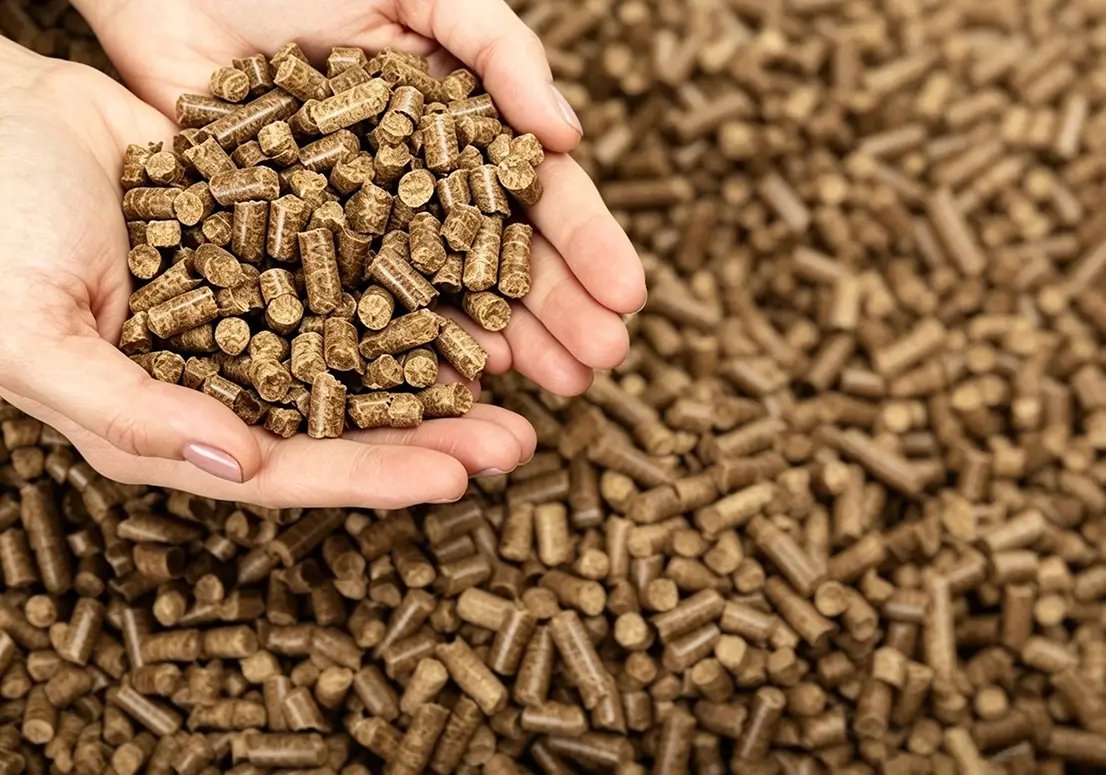
The forming section compresses the prepared sawdust into pellets.
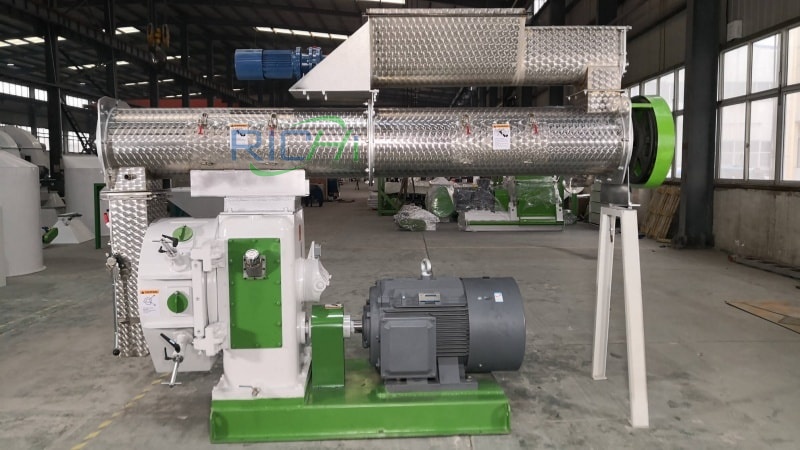
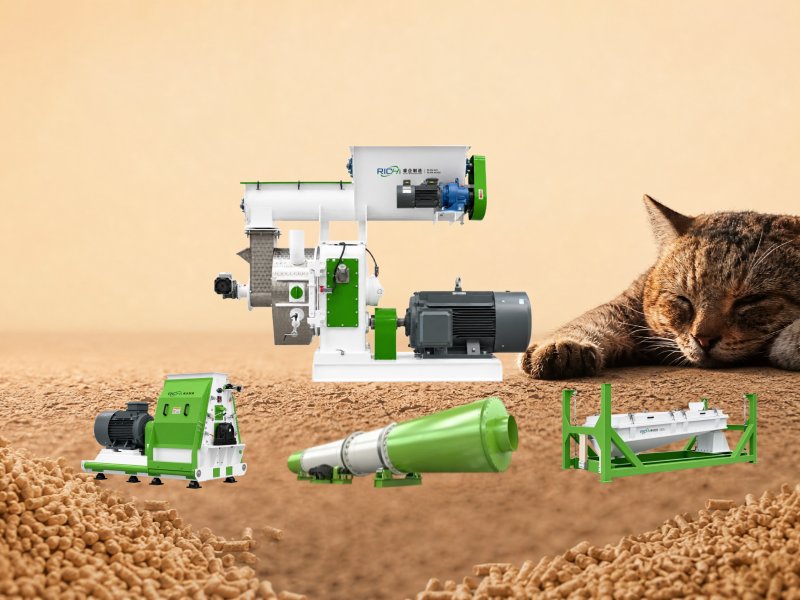
The selected Sawdust Cat Litter Production Equipment should be matched to the raw material and product specifications rather than selected on output alone.
Different operating conditions can change pellet density and durability.
This is why commissioning and process adjustment are essential after installation.
A machine may have a rated capacity, but operators still need to establish the working conditions that provide an acceptable balance between output and product quality.
Why Cooling Cannot Be Ignored
Freshly formed pellets may need time to stabilize before packaging.
Cooling can help reduce product temperature and support more stable handling.
If pellets enter the screening and packing stages before they are properly conditioned, breakage may increase.
This creates additional fines.
The result is a classic example of a downstream issue being caused by an earlier process stage.
Therefore, dust reduction is not only about the forming machine.
Cooling deserves equal attention.
Screening Protects the Customer Experience
Screening helps separate particles that fall outside the desired size range.
This is important because very small fragments often contribute significantly to visible dust.
By controlling the particle distribution before packaging, manufacturers can create a cleaner and more consistent product.
Screening also provides useful process information.
If the percentage of fines suddenly increases, the operator can investigate potential causes such as moisture changes, raw-material variation, forming conditions, or mechanical wear.
Quality control therefore becomes a feedback system rather than a final inspection step.
Gentle Conveying Can Reduce Breakage
Even well-formed pellets can produce dust if they are handled aggressively.
Repeated impacts, unnecessary transfer points, and excessive drop heights can increase breakage.
This means plant layout matters.
The shortest material route is not always the best route.
Designers should consider how much mechanical stress the product experiences between forming and packaging.
Reducing unnecessary movement can help preserve pellet integrity.
Packaging Can Create a Hidden Problem
Packaging equipment may appear to be the final step, but it can influence dust significantly.
When bags are filled too aggressively, pellets can collide with each other and generate more fines.
If the packaging process includes multiple drops or transfer points, product damage can occur immediately before the customer receives it.
A good packaging system should therefore preserve the quality created by the upstream process.
There is little value in carefully controlling dust at the forming stage if the finished product is broken during packing.
Storage Conditions Also Matter
Wood-based litter can change physically during storage.
High humidity may affect product condition.
Long periods of mechanical pressure can influence how particles behave.
Transport vibrations can create fines.
Therefore, manufacturers should evaluate packaged samples after storage and transportation simulation, not only immediately after production.
This is particularly relevant for brands selling through long distribution channels.
How Absorption Changes the Design
Dust is important, but it is only one part of product performance.
A cat litter must also behave properly when it encounters moisture.
Manufacturers may choose to create pellets that remain intact while absorbing liquid or products that soften and break apart.
This decision can influence pellet density and structure.
As a result, dust reduction should never be achieved at the expense of the product’s intended absorption behavior.
The correct target is a balanced product.
Why Testing Should Include Real-World Handling
Laboratory measurements are useful, but real-world handling can produce different results.
A manufacturer may test a freshly screened product and find an acceptable dust level.
The same product might generate more fines after being conveyed several meters, dropped into bags, stacked on pallets, and transported by truck.
A complete quality program should therefore test the product at several points.
Factory exit is only one of them.
Matching Capacity with Product Quality
High output is attractive, but increasing throughput can change process behavior.
When production speed increases, drying time, cooling performance, screening load, and conveying conditions may all change.
This means capacity expansion should be evaluated as a system.
Companies looking at a 3-4 T/H sawdust pelletizer for sale should therefore examine not only forming capacity but also what happens before and after the forming stage.
A system is only truly capable of high output if every section can maintain acceptable product quality at that output.
Maintenance and Dust Control
Mechanical wear can also influence pellet quality.
Worn components may alter compression behavior.
Poorly maintained conveyors can create extra impacts.
Blocked screens can change particle distribution.
Inadequate dust collection can affect factory cleanliness even when the finished product itself is acceptable.
Preventive maintenance should therefore form part of the production strategy.
A clean, well-maintained plant can support more consistent product conditions.
A Process-First View of Quality
Instead of asking “How do we reduce dust?”, manufacturers can ask a broader series of questions:
Is the raw material consistent?
Is moisture stable?
Are particles properly prepared?
Is the forming stage operating in the intended range?
Is cooling sufficient?
Is screening removing excess fines?
Are conveyors causing breakage?
Is packaging gentle enough?
Does the final product remain stable during transport?
This process-first approach often reveals that dust is the result of several small factors rather than one large problem.
A Better Way to Evaluate Equipment
When comparing pellet press, buyers should request information about the conditions behind the quoted performance.
What raw material was tested?
What moisture level was used?
What pellet size was produced?
How much screening loss occurred?
What final dust level was observed?
How was cooling handled?
These questions are far more informative than a single capacity number.
Technical documentation and check my source references related to wood processing can also help manufacturers understand the relationship between raw-material properties and final product performance.
Conclusion
Low-dust wood-based cat litter is not created by a single machine feature.
It is the result of coordinated control across raw-material sourcing, particle preparation, moisture management, forming, cooling, screening, conveying, packaging, and storage.
Manufacturers that focus only on pellet shape may miss the factors that determine what customers actually experience when the bag is opened.
A better strategy is to define the desired consumer experience first and then build the production process around it.
For brands entering the biodegradable cat litter market, that process-based approach can make a meaningful difference in consistency, transport stability, and customer satisfaction.