




Producing consistent cattle feed is not simply a matter of grinding several ingredients and pressing them into pellets. The quality of the final feed depends on raw-material characteristics, formulation, particle size, moisture, pellet diameter, production capacity, and the way the complete processing system is designed.
For farms and feed manufacturers, pelletizing can provide several practical advantages. Compared with loose feed, pellets are easier to handle, transport, store, and distribute. A well-formulated pellet can also help reduce ingredient separation, making it easier to provide cattle with a relatively consistent mixture.
However, selecting equipment requires more thought than simply comparing motor power or purchase prices.
A suitable system should match the type of cattle being fed, the available raw materials, the expected daily output, and the intended production method. This article explains the main factors to consider when planning a cattle feed pellet production project.
Why Is Cattle Feed Often Made Into Pellets?
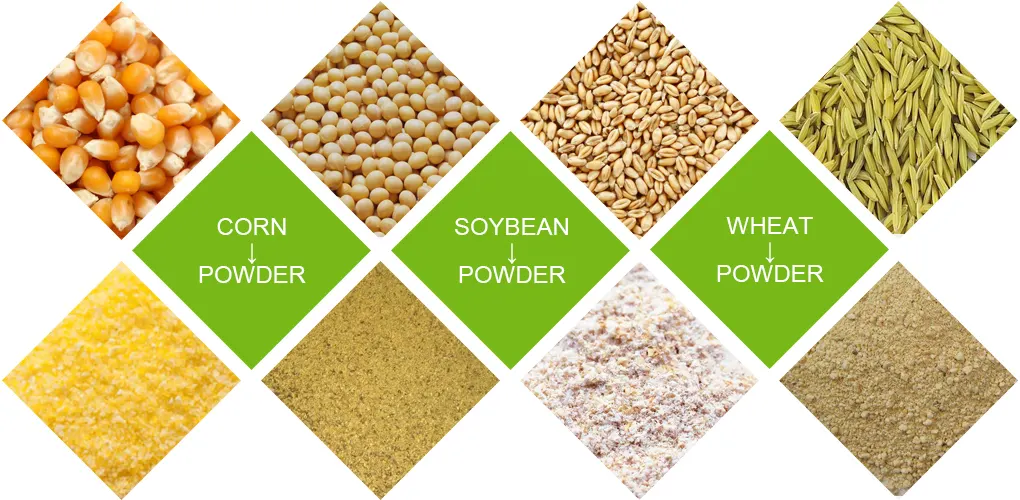
Cattle diets can contain a wide range of ingredients, including corn, wheat bran, soybean meal, alfalfa, grass meal, rice bran, mineral additives, and other agricultural materials.
These ingredients can differ significantly in particle size and density. When supplied as a loose mixture, lighter particles may separate from heavier materials during transportation and handling.
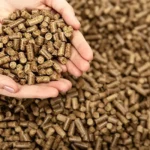
Pelletizing compresses the mixture into a more uniform physical form.
Pellets can also make storage and transportation more convenient. Depending on the formulation, the compression process may increase bulk density and reduce the amount of space needed for a given weight of feed.
However, pelletizing should be considered a processing method rather than a substitute for proper nutrition formulation.
What Raw Materials Are Commonly Used?
Cattle feed formulas vary according to animal type, growth stage, production purpose, local ingredient availability, and feeding strategy.
A typical formula may contain energy ingredients such as corn or other grains, protein sources such as soybean meal, fiber-rich materials such as alfalfa or grass meal, and mineral or vitamin supplements.
The exact proportions should be determined according to nutritional requirements rather than simply following a general recipe.
For example, feed intended for growing cattle may have different protein and energy requirements from feed formulated for mature beef cattle.
The first step in designing a pellet plant is therefore to understand the intended feed formula.
Does Particle Size Matter Before Pelletizing?
Yes. Particle size is an important factor in both feed quality and pellet-mill performance.
Large particles can make mixing less uniform and may create difficulties when the material enters the pellet mill.
Grinding the raw materials into a suitable and relatively consistent particle size helps improve mixing and pellet formation.
However, grinding everything into extremely fine particles is not necessarily better.
Very fine grinding consumes more electricity and can increase dust generation.
The ideal particle size should be selected according to the feed formula, pellet diameter, raw-material characteristics, and equipment design.
How Does Moisture Affect Pellet Quality?
Moisture has a direct effect on pellet formation.
If the material is too dry, the particles may not bind effectively, resulting in weak pellets with excessive fines.
If the material contains too much moisture, the pellets may become soft or cause problems during cooling and storage.
The appropriate moisture level depends on the raw materials and pellet-mill configuration.
Some feed plants use steam conditioning before pelletizing. Steam introduces heat and moisture into the feed mixture, helping soften the material and improve the pelletizing process.
The exact conditioning conditions should be adjusted according to the formula rather than applied as a fixed setting to every feed.
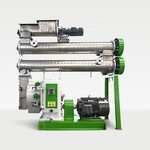
What Does a Cattle Feed Pellet Mill Actually Do?
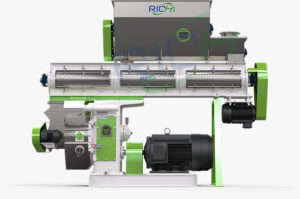
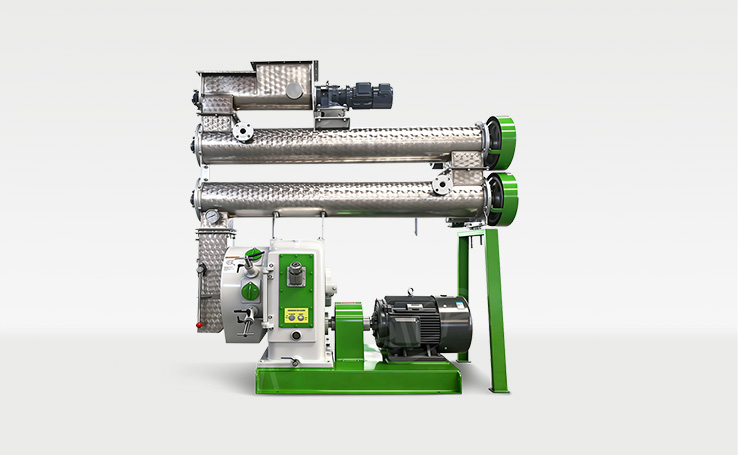
A pellet mill compresses prepared feed material through holes in a die.
The feed enters the pelleting chamber, where rollers press the material through the die openings. The resulting continuous strands are cut into pellets by knives positioned near the die.
The diameter of the die holes determines the basic pellet diameter, while knife position and operating conditions influence pellet length.
Different pellet sizes may be used for different cattle feeding situations.
A mill designed for commercial production may also incorporate automatic feeding, lubrication, conditioning, and control systems.
The pellet mill is therefore one important component of the process, but it relies on good grinding, mixing, and conditioning upstream.
What Should You Look for When Buying a Pellet Mill?
When comparing a cattle feed pellet mill for sale, it is useful to look beyond the advertised capacity.
Important questions include:
- What raw materials can the machine handle?
- What pellet diameter is required?
- Is steam conditioning needed?
- What is the realistic production capacity?
- What motor power is required?
- How often do wearing parts need replacement?
- Are spare parts readily available?
- How easy is the machine to clean and maintain?
- Can the system be expanded later?
A machine rated at a certain capacity under ideal conditions may produce less when processing a difficult formula.
Capacity should therefore be considered in relation to the actual feed mixture.
Should Cattle Feed Be Conditioned With Steam?
Steam conditioning is widely used in commercial pellet production.
When steam enters the feed mixture, it increases temperature and moisture while helping soften the ingredients.
This can improve pellet formation and reduce the mechanical load on the pellet mill.
Steam can also contribute to starch gelatinization, depending on the feed composition and conditioning conditions.
However, steam is not automatically necessary for every small-scale project.
A compact farm-based system may operate without a dedicated boiler and conditioning system.
The decision depends on production capacity, formula, desired pellet quality, and available infrastructure.
What Pellet Size Is Suitable for Cattle?
There is no single pellet diameter that works for every cattle feed.
The appropriate size depends on animal age, feeding method, ration composition, and management practices.
Young animals generally require feed that is easier to consume, while mature cattle can handle larger particles.
The physical structure of the ration is also important because cattle have specific requirements for effective fiber and chewing activity.
Pelletizing should therefore not be used to make the entire ration excessively fine simply because small pellets are easier to produce.
A balanced formulation should preserve the nutritional and physical characteristics required by the animals.
Is Alfalfa Suitable for Cattle Feed Pellets?
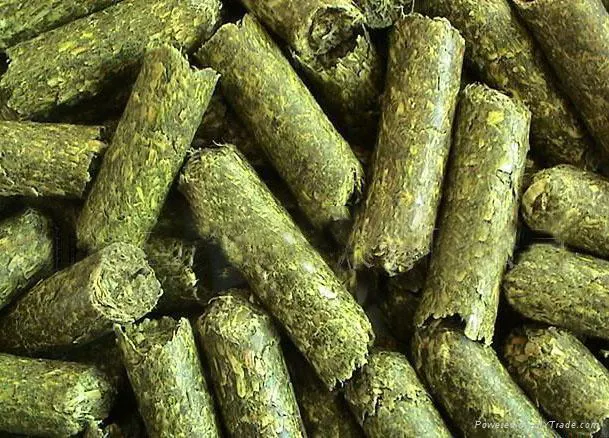
Alfalfa is widely used in cattle diets because of its protein, fiber, and mineral content.
It can be processed into pellets either as a major ingredient or as part of a mixed ration.
Before pelletizing, alfalfa may need to be chopped or ground to a suitable size.
Its moisture content also affects pellet formation.
If the material is too wet, drying may be necessary. If it is too dry, additional moisture or conditioning may improve pellet quality.
The same principle applies to other forage materials such as grass meal and crop residues.
Can Straw Be Added to Cattle Feed Pellets?
Certain processed crop residues can be incorporated into cattle feed, depending on their nutritional characteristics and suitability for the intended animals.
Straw is relatively high in fiber and may require chopping, grinding, or other treatment before incorporation into a feed formula.
The proportion used should be determined by nutritional requirements.
From a processing perspective, long fibers can also affect grinding and pellet formation.
A hammer mill or forage grinder may therefore be necessary when processing large quantities of fibrous material.
How Large Should the Feed Production Line Be?
The required capacity should be based on actual feed demand.
For a small cattle farm, a low-capacity line may be sufficient for producing feed for its own animals.
A commercial feed manufacturer supplying several farms may need a much larger system.
Capacity should also consider operating hours.
A plant that runs eight hours per day will require a different nominal capacity from one that operates around the clock.
Seasonal demand is another factor.
If feed demand increases during certain periods, some spare capacity may be useful.
What Equipment Is Normally Included?
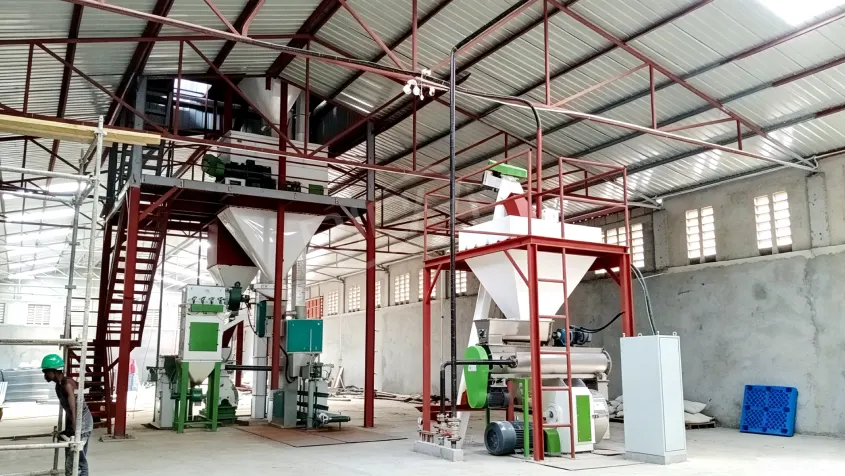
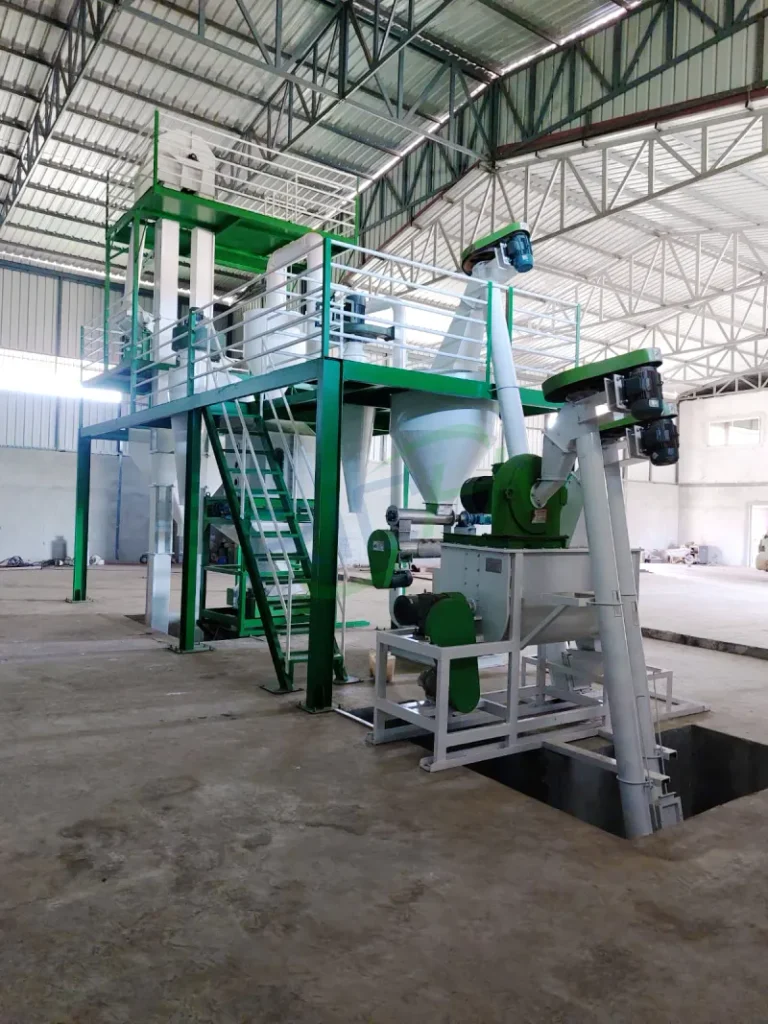
A complete cattle feed pellet production line can contain several processing stages.
A typical process may include:
Raw-material receiving → Cleaning → Crushing → Batching → Mixing → Conditioning → Pelletizing → Cooling → Screening → Packaging
Depending on the raw materials, additional equipment may be necessary.
For example, forage-rich formulas may require specialized chopping or grinding equipment.
If liquids such as molasses or oil are included, a liquid-addition system may be required.
Not every project needs every piece of equipment.
The equipment configuration should be based on the actual feed formula and production target.
Does a Cattle Feed Plant Need Liquid Addition Equipment?
It depends on the formula.
Some cattle feed formulations contain molasses, oil, or other liquid ingredients.
Liquid addition equipment helps distribute these ingredients more evenly throughout the feed mixture.
Without controlled dosing, liquid ingredients may be unevenly distributed, causing variations in feed composition.
For small operations, liquid addition may sometimes be performed manually.
For larger plants, automated pumps, flow meters, tanks, and spraying systems can provide greater consistency.
The need for liquid equipment should therefore be evaluated during the formulation and process-design stage.
How Much Does a Cattle Feed Plant Cost?
People often ask how much does a cattle feed plant cost, but the answer depends on the scope of the project.
A small farm-level pellet system may require only a grinder, mixer, pellet mill, cooler, and basic conveying equipment.
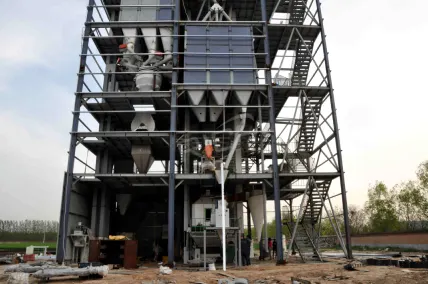
A commercial plant may additionally require automatic batching, multiple raw-material bins, conveyors, steam conditioning, pellet cooling, screening, packaging, dust collection, electrical controls, storage buildings, and other infrastructure.
Therefore, equipment capacity alone does not determine total investment.
Civil construction, electrical installation, storage, transportation, labor, energy systems, and environmental requirements can all contribute to the final project cost.
A realistic budget should include both equipment and supporting infrastructure.
Does Automation Increase the Initial Investment?
Generally, a higher level of automation requires additional equipment and control systems.
Automatic batching systems can weigh ingredients according to predefined formulas.
Automated liquid dosing can improve the accuracy of molasses or oil addition.
Centralized control systems can coordinate conveyors, grinders, mixers, pellet mills, and other equipment.
These features can increase the initial investment but may reduce manual labor and improve consistency during long-term operation.
For small farms, manual operation may be more economical.
For commercial plants, automation can become more valuable as production volume increases.
What Happens If the Pellet Mill Produces Too Many Fines?
Excessive fines can have several causes.
The feed formula may not contain enough natural binding material. Moisture may be inappropriate. Steam conditioning may be insufficient.
The die and roller condition can also influence pellet formation.
If the die is worn, compression may become less effective.
Grinding and mixing problems can also contribute to inconsistent pellets.
The solution is therefore not always to increase compression pressure.
The entire process should be checked from raw-material preparation through conditioning and pelletizing.
What About Energy Consumption?
Energy consumption is an important operating cost.
Grinding can require substantial electricity, particularly when fibrous materials are reduced to small particles.
Pelletizing also requires mechanical power.
If steam conditioning and drying are used, the total energy requirement increases further.
For this reason, energy efficiency should be considered at the process-line level.
Using an appropriately sized grinder, avoiding unnecessary over-grinding, maintaining the pellet mill properly, and optimizing steam conditions can all help reduce energy consumption.
How Should a Feed Plant Be Laid Out?
Material flow should be the starting point for plant layout.
Raw materials should move logically through grinding, batching, mixing, conditioning, pelletizing, cooling, screening, and packaging.
Unnecessary transportation increases labor requirements and can make maintenance more difficult.
The plant should also include adequate space around each machine.
Maintenance teams need access to motors, bearings, dies, rollers, conveyors, and other components.
Raw-material storage and finished-product storage should also be positioned to minimize unnecessary vehicle movement.
Related Post: https://commercialpelletmill.com/livestock-feed-production-line/
How Important Is Raw-Material Storage?
Proper storage protects feed ingredients from moisture, pests, and contamination.
Grains and meals should be stored under conditions appropriate to their characteristics.
High-moisture ingredients may require additional management.
Mineral and vitamin additives should also be kept dry and protected from contamination.
Poor storage can reduce feed quality before the ingredients even reach the processing line.
The storage system should therefore be treated as part of the feed-production process rather than as a separate warehouse issue.
Can One Production Line Make Different Cattle Feeds?
A well-designed production line can often manufacture multiple formulas.
The formulation can be changed through the batching and mixing system, while different pellet diameters can be produced by changing the die.
However, frequent product changes require cleaning and may cause material losses.
For commercial plants, production scheduling can reduce unnecessary changeovers.
Similar formulas can be grouped together to improve efficiency.
A multi-product plant should also consider whether the mixer and batching system can accurately handle all required ingredients, especially when formulas contain small quantities of additives.
What Should Be Considered Before Buying Equipment?
Before contacting equipment suppliers, it is useful to prepare several basic parameters.
These include:
- Target production capacity
- Raw-material types
- Feed formulas
- Pellet diameter
- Working hours
- Desired automation level
- Available electricity
- Whether steam is available
- Available site area
- Packaging requirements
The more complete this information is, the more meaningful an equipment proposal can be.
Without this information, two suppliers may quote completely different systems, making direct price comparison difficult.
How Can Supplier Quotations Be Compared?
A quotation should be evaluated according to scope rather than price alone.
One supplier may quote only the pellet mill.
Another may include grinding, mixing, conditioning, cooling, screening, conveyors, electrical controls, and packaging.
These are not equivalent offers.
Companies such as pellet making machine can be considered when researching equipment and complete processing solutions for feed-related applications.
When comparing suppliers, it is useful to create a checklist showing which machines, installation services, spare parts, controls, and technical support are included.
This makes the comparison more transparent.
What Is the Difference Between a Small Farm Line and a Commercial Plant?
A small farm line generally focuses on simplicity.
It may use manually loaded ingredients, a basic grinder, a mixer, a pellet mill, and a simple cooling or drying arrangement.
A commercial plant requires greater process control.
Automatic batching, continuous conveying, steam conditioning, cooling, screening, packaging, dust collection, and centralized controls may all be necessary.
The difference is not simply production capacity.
It is also about consistency, labor requirements, product variety, storage, and operational continuity.
How Long Does It Take to Build a Cattle Feed Plant?
Construction time varies according to project scale.
A small system assembled in an existing building may require relatively little civil work.
A large commercial facility can involve building construction, concrete foundations, electrical systems, storage structures, equipment manufacturing, transportation, installation, commissioning, and operator training.
The timeline should therefore be divided into several stages.
Site preparation can often begin before machinery arrives.
This helps reduce delays during installation.
Can a Feed Plant Be Expanded Later?
Yes, but expansion is easier when considered during the initial design.
For example, the building can reserve space for additional silos, a second pellet mill, larger cooling equipment, or automated packaging.
Electrical capacity can also be planned with some future flexibility.
However, expansion should be based on realistic demand forecasts.
Designing a plant far beyond current requirements can increase the initial investment unnecessarily.
A balanced approach is to build the core system around current demand while leaving practical room for future upgrades.
What Maintenance Is Required?
Feed-processing machinery requires regular maintenance because it operates under continuous mechanical loads.
Grinding equipment needs inspection of hammers, screens, bearings, and drive components.
Pellet mills require attention to dies, rollers, lubrication, and other wear parts.
Conveyors should be checked for belt alignment and bearing condition.
Cooling and screening systems also need regular cleaning.
Preventive maintenance is generally more effective than waiting for equipment to fail.
Keeping spare wearing parts available can also reduce downtime.
What Is the Most Important Principle When Choosing a Pellet Mill?
The most important principle is to match the equipment to the feed rather than selecting equipment first and trying to adapt the feed later.
Raw materials determine grinding requirements.
The formulation affects mixing and pelletizing.
Pellet diameter influences die selection.
Production capacity determines equipment size.
The desired level of automation affects the control system.
The plant location determines power, steam, storage, and transportation requirements.
Once these factors are understood, equipment selection becomes much more straightforward.
Final Thoughts: How Should a Cattle Feed Pellet Project Be Planned?
A cattle feed pellet project should begin with the animals and the feed formula, not with a machine catalog.
First, determine what cattle will be fed and what nutritional characteristics the ration needs.
Next, identify the available raw materials and understand their moisture, fiber, particle-size, and processing characteristics.
Then determine the desired daily production capacity and pellet size.
Only after these parameters are clear should the grinding, mixing, conditioning, pelletizing, cooling, screening, and packaging systems be selected.
The investment should also be evaluated as a complete project. Equipment purchase, installation, electricity, steam, storage, labor, maintenance, and future expansion can all influence the actual operating economics.
For farms with modest feed requirements, a compact processing setup may be sufficient. For commercial manufacturers, a complete automated production line can provide greater control and consistency.
The key is not to purchase the largest or most sophisticated equipment available. It is to build a processing system that fits the raw materials, feed formula, production target, and practical operating conditions.
When these factors are considered together, cattle feed pellet production becomes easier to plan, easier to operate, and more predictable over the long term.